
The “Growth Truth” Dashboard: The Only 3 SaaS Metrics That Matter

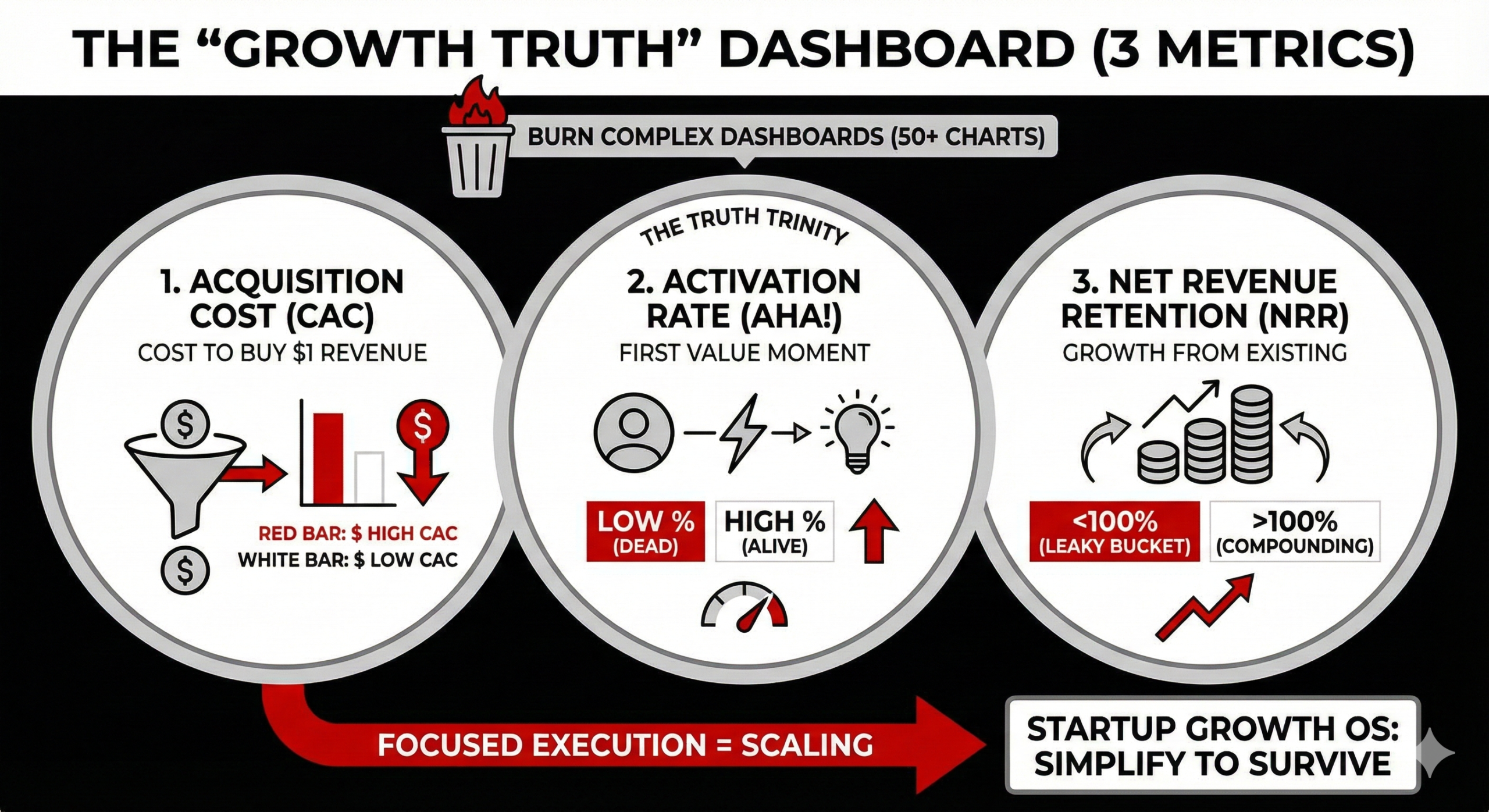
You should burn your dashboard before you drown.
You sit there, staring at a screen filled with forty-two different widgets, colorful pie charts, and trend lines that go up and to the right, and you tell yourself that you are in control. You are not. You are lost in a fog of war that you created to protect your own ego from the terrifying reality of your business.
The market is ruthless.
It does not care about your “Vanity Metrics.” It does not care about your “Total Addressable Market” or the number of eyeballs that glanced at your landing page for three seconds before scrolling away in disgust. We are in the “Default Dead” state.
Gravity is pulling us down. Entropy is eating our margins. The AI consolidation is hunting the weak, and right now, you look like prey.
You look like prey because you are confused.
You have bought into the lie of the “Data-Driven Founder,” a myth sold by consultants and VC associates who have never had to make payroll on a Friday afternoon. They told you to measure everything. They told you that more data equals more truth.
They lied.
Complexity is the enemy of execution.
You have built a dashboard that looks like the cockpit of a 747, but you are flying a glider off a cliff. You are tracking “Social Sentiment” while your cash runway burns. You are optimizing “Click-Through Rates” while your churn quietly strangles you in your sleep.
You need the “Growth Truth” Protocol.
You do not need fifty charts. You need three.
If you cannot run your entire company on a post-it note, you are not a CEO; you are a bureaucrat. You are hiding behind the noise because the silence of the truth scares you.
Tear it down.
Delete the widgets. Unplug the API integrations. Stop staring at the noise.
We are going to build the only dashboard that matters.
This is not a reporting structure but a survival mechanism.
In the trenches of 2026, where capital is scarce, product shipping is in minutes, and attention is nonexistent, you can only afford to focus on the physics of your business. Everything else is a distraction. Distraction is death.
The “Growth Truth” consists of three numbers:
- Acquisition Cost (The Price of Blood).
- Activation Rate (The Heartbeat).
- Net Revenue Retention (The Oxygen).
That is it.
If you ignore this simplicity, you choose paralysis. You choose to be the general who is so busy reading weather reports that he fails to see the enemy flanking his position.
The failure state is not just bankruptcy; it is irrelevance. It is waking up in six months with a bank account that reads zero, wondering how you failed when all your “engagement metrics” looked so green.
You failed because you were looking at the map, not the terrain.
You can leave the 50 widgets to your Marketer or CMO if you have one.
What you should worry about as a founder is these three.
1. The Fog of War Kills
War is chaos.
Your startup is a war zone. In the heat of battle, when the servers are crashing and the customers are screaming, you do not have the cognitive bandwidth to process complex data. You need signal.
You need to know if you are winning or dying.
When you track fifty metrics, you create a “Fog of War” inside your own organization. Your team does not know what matters. Your sales lead thinks “Calls Made” is the goal. Your marketing lead thinks “Impressions” is the goal. Your product lead thinks “Features Shipped” is the goal.
They are all wrong.
They are optimizing local maximums while the ship sinks. By stripping the dashboard down to the Trinity: CAC, Activation, NRR, you clear the fog. You align the sights of every rifle in your platoon on the same target.
Clarity is violence.
Use it to cut through the noise and strike where it hurts.
2. The Apple Lesson: Steve Jobs and the Grid
History leaves clues.
Look at Apple in 1997. The company was weeks away from bankruptcy, bleeding cash, and suffocating under a product line so complex that even the employees didn’t know what they were selling. They had a dozen versions of the Macintosh. They had Newtons. They had printers.
They had data everywhere, and they were dying.
Steve Jobs returned from the wilderness. He did not ask for more market research. He did not ask for more spreadsheets.
He walked to a whiteboard.
He drew a simple grid. Two columns: “Consumer” and “Pro.” Two rows: “Desktop” and “Portable.”

Four quadrants. Four products.
He killed everything else. He slaughtered 70% of the roadmap in a single afternoon because he understood that focus is not about saying yes; it is about saying no with a sledgehammer. He reduced the company’s “Dashboard” to four squares.
And he saved the world.
You are not Apple, but the physics are the same. If you have twenty pricing tiers and fifteen customer segments, you are recreating the chaos of 1997. Kill the complexity. Draw your grid. Focus or die.
3. CAC is the Speed of Death
Most of you treat Customer Acquisition Cost (CAC) as a marketing metric.
It is not. It is a death clock.
If it costs you $1.00 to buy a customer and you only have $10,000 in the bank, you have 10,000 bullets left. If you miss, you die.
Founders complicate this. They talk about “Blended CAC” and “Organic Lift.” Stop lying to yourself.
You need the raw, unvarnished cost of buying revenue. If that number is higher than the immediate cash flow the customer provides, you are bleeding. The “Growth Truth” demands that you stare at this number every morning.
It forces you to be ruthless.
It forces you to kill the channels that are “kind of” working. It forces you to hunt for the vein of gold where the CAC is low and the volume is high. If you hide this number inside a “Blended” average, you are hiding the tumor that will kill you.
4. Activation: The Uber “One Ride” Obsession
Signups are vanity. Activation is sanity.
A user who signs up and does nothing is not a user; they are a ghost. They cost you money to host, but they give you nothing in return.
You must measure the pulse.
Look at Uber in the early days. They did not care about “App Downloads.” A download is meaningless if the user never opens the app.
They obsessed over “The First Ride.”
They knew, through brutal data analysis, that if a user took one ride, they were hooked. If they took zero rides, they churned. So the entire company, every engineer, every marketer, every driver ops manager, was focused on that single metric.
How do we get them to take the First Ride?
They gave away free rides. They subsidized drivers to ensure low wait times. They moved heaven and earth to force that activation event because they knew it was the bridge between “Tourist” and “Citizen.”
Your dashboard probably tracks “Signups.” Burn it.
Track the moment they become alive. Track the “Aha!” moment. If that number isn’t moving, your product is dead, and no amount of marketing will save it.
5. NRR: The Snowflake Compounder
Net Revenue Retention (NRR) is the holy grail.
It measures how much your existing customers grow without you lifting a finger. If your NRR is above 100%, you are “Default Alive.” If you stopped sales today, you would still grow.
Look at Snowflake.
When Frank Slootman took over, he didn’t just focus on selling new logos. He focused on consumption. He built a machine where customers naturally spent more every single month.
Snowflake achieved an NRR of 158%.
Do the math. Every year, their revenue base grew by 58% purely from existing customers. They were fighting a war with a cheat code. They started every year more than halfway to their goal.
Most of you have an NRR of 80%.
You are filling a leaky bucket. You are running on a treadmill that is speeding up, and eventually, you will trip and break your neck. The “Growth Truth” dashboard puts NRR front and center because it forces you to love your customers.
It forces you to build a product that expands, not just one that sells.
6. Speed of Decision (The OODA Loop)
In aerial combat, there is a concept called the OODA Loop.
Observe. Orient. Decide. Act.
The pilot who moves through this loop faster wins. The pilot who hesitates dies.
Business is aerial combat.
When your dashboard is complex, your OODA Loop is slow. You spend three days analyzing the data, two days arguing about the attribution model, and one day making a decision. That is a week lost.
In that week, your competitor stole your market share.
When you have three metrics, your OODA Loop is instantaneous. CAC went up? Kill the ad. Activation went down? Fix the onboarding. NRR is flat? Call the top customers.
You decide in minutes. You act in hours.
This speed compounds. If you make 100 correct decisions while your competitor is still building a pivot table, you win by default. Simplicity is speed. Speed is life.
7. Investor Psychology: The Smell of Competence
Investors are sharks.
They smell fear. They smell confusion. When you walk into a pitch meeting and show a slide deck with thirty different charts, you think you look sophisticated.
You look like an amateur.
You look like someone who doesn’t know what drives their business. You are throwing spaghetti at the wall to see what sticks.
But when you walk in with three numbers.
“My CAC is $500. My Activation is 40%. My NRR is 120%.”
And you explain exactly how you pull the levers to move those three numbers.
The room changes. The VC stops looking at their phone. They realize they are talking to a mechanic, not a magician.
They back mechanics. They invest in operators who know the machine. Simplicity signals mastery. Complexity signals insecurity.
8. Resource Allocation: Starve the Losers
You have limited resources.
You have limited cash, limited engineering hours, and limited mental energy. You cannot afford to waste a single ounce of it on things that do not move the needle.
The “Growth Truth” dashboard acts as a razor.
It cuts away the fat. If a project does not lower CAC, increase Activation, or boost NRR, why are we doing it?
“But it’s good for brand awareness!”
Kill it.
“But it’s a cool feature!”
Kill it.
“But the competitors are doing it!”
Let them die.
You must be ruthless with your resources. You must starve the losers so you can feed the winners. This focus allows you to punch above your weight class. It allows a team of five to out-execute a team of fifty because the team of five is a laser and the team of fifty is a flashlight.
9. The $300k ARR Trap
You are stuck at $300k ARR.
This is the “Valley of Death.” It is too big to be a hobby, but too small to be a scale-up. You are grinding.
The reason you are stuck is that you are trying to scale complexity.
You are adding sales reps before you have fixed Activation. You are pouring money into ads before you have fixed NRR. You are trying to run a marathon with a broken leg.
The dashboard forces you to fix the foundation.
It screams at you that your Activation is only 15%. Until you fix that, nothing else matters. It stops you from premature scaling. It forces you to earn the right to grow.
Escape velocity requires structural integrity.
Build the hull before you ignite the thrusters.
10. The Regret Minimization Framework
Fast forward to the end.
Imagine your startup failed. You are writing the post-mortem. You are explaining to your family why you lost their money.
Will you say, “I wish I had tracked more metrics?”
No.
You will say, “I wish I had focused.”
You will regret the time you spent on vanity projects. You will regret the weeks you wasted on partnerships that went nowhere. You will regret the complexity that blinded you.
The “Growth Truth” dashboard is a time machine.
It brings that future regret into the present so you can avoid it. It forces you to do the hard work now. It forces you to look at the ugly numbers now.
It hurts.
But the pain of discipline is far less than the pain of regret. Choose the pain of truth.
It is time to make a choice.
You can keep the forty-two widgets. You can keep the illusion of control. You can keep telling yourself that you are “data-driven” while you drift slowly into the abyss of the Default Dead.
Or you can choose the Truth.
You can delete the dashboard. You can strip your business down to the studs. You can stare at the CAC, the Activation, and the NRR until they burn into your retinas.
It is terrifying.
When you remove the noise, you have nowhere to hide. If the numbers are bad, they are bad. But that fear is good. That fear is fuel.
You cannot fix what you cannot see.
If you are ready to stop playing startup and start building a war machine. If you are ready to install the Startup Growth OS into your chaotic business.
I want you to apply.
I do not work with tourists. I work with founders who are ready to bleed for their vision.
Apply to the Startup Growth OS below.
We will jump on a call. We will look at your three numbers. We will find the truth.
And then we will build.
Sam Femi – Startup Growth Architect.