Prep for Interviews Like a Pitch

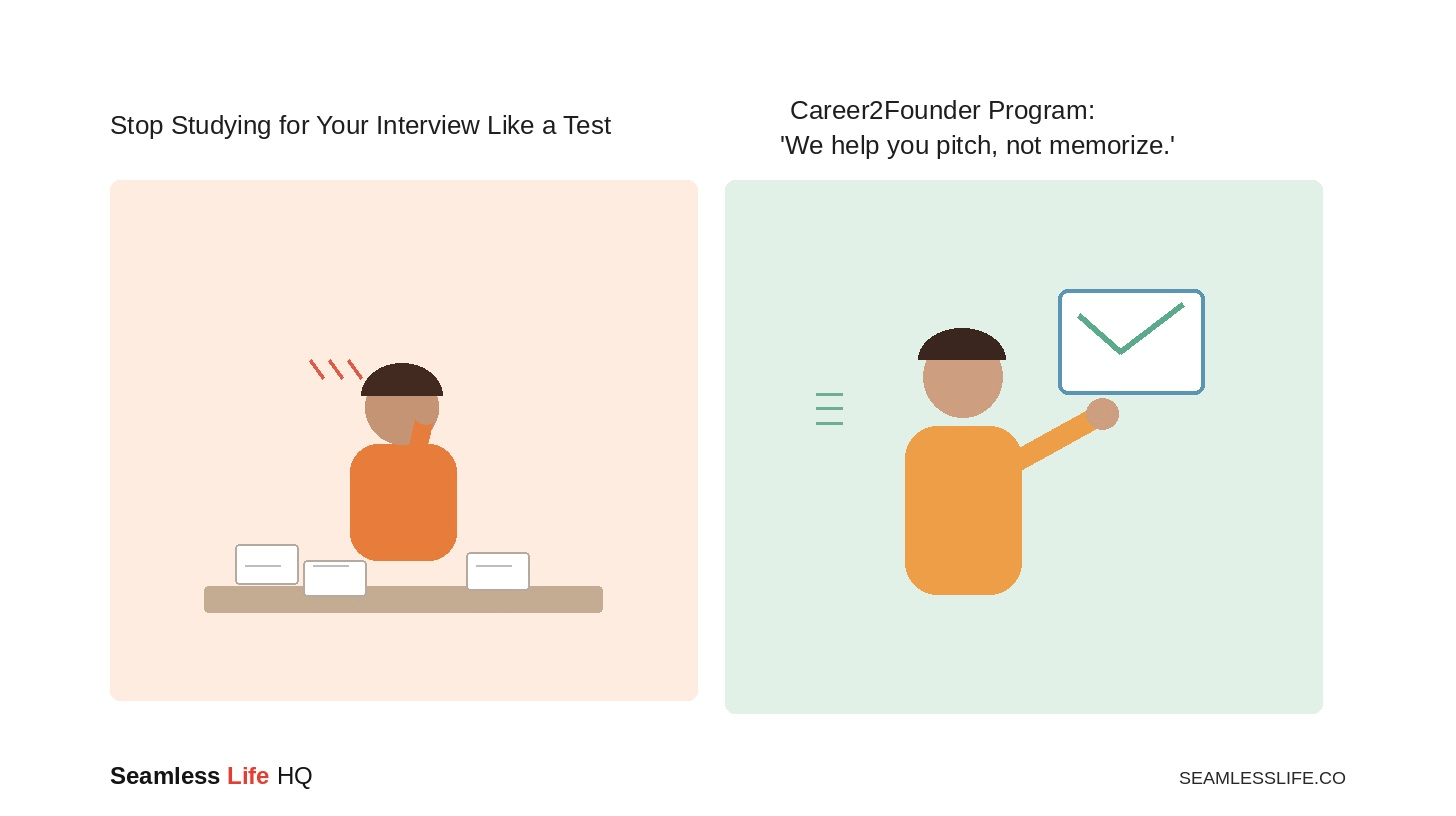
Most interview prep looks like exam prep: rereading the job description, rehearsing answers to a list of anticipated questions, hoping to recall the right facts under pressure. That approach treats the interview as a comprehension check, something you either know or don’t, pass or fail based on whether you retained the material.
That framing is wrong, and it is wrong in a way that quietly sabotages otherwise strong candidates. An interview is not measuring whether you know things. It is measuring whether the interviewer wants to bet their own credibility on hiring you. That is a persuasion problem, not a knowledge problem, and persuasion problems require pitch prep, not study prep.
A pitch has a thesis, a structure, and a specific outcome it is built to produce. Studying has none of those. Here is what changes when you prepare like the former instead of the latter.
What Pitch Prep Actually Looks Like
1. A Pitch Has One Core Thesis. Study Prep Has None.
Someone preparing to study for an interview walks in with a scattered set of facts about their background, ready to answer whatever comes up. Someone preparing a pitch walks in with one clear thesis: here is specifically why I am the right bet for this exact problem, and every answer in the conversation, regardless of the question asked, gets steered back toward reinforcing that thesis.
Before any interview, write the thesis in one sentence: the specific combination of experience, judgment, and outcome that makes you the right answer to this specific role’s specific problem. Every story, every answer, every question you ask should trace back to that sentence. Without it, even strong individual answers add up to a blur instead of a case.
2. A Pitch Anticipates Objections Instead of Hoping They Don’t Come Up
Studying for an interview means hoping the gaps in your background don’t get noticed. Pitching means identifying the most obvious objection an interviewer will have, the skill gap, the industry switch, the shorter tenure at your last role, and building a direct, confident answer to it before it’s ever asked, instead of scrambling to explain it in the moment.
This is uncomfortable to do honestly, which is exactly why most candidates skip it. Sit down and write out the two or three reasons a skeptical interviewer might hesitate on you specifically. Then build a short, honest, confident response to each one. Objections handled in advance land as self-aware and credible. Objections handled for the first time live, under pressure, land as defensive, even when the underlying answer was fine.
3. A Pitch Ends With a Close. Studying Just Ends When the Questions Stop.
Exam prep treats the end of the interview as the finish line, the last question answered correctly, done. Pitch prep treats the end as the moment to actively move the conversation forward: a specific, confident closing question about next steps, a brief restatement of the thesis, a clear signal of genuine interest instead of a passive “thanks for your time.”
Most candidates leave this on the table entirely, ending on whatever the interviewer’s last question happened to be instead of taking one final beat to reinforce the case they just built. A closing line as simple as “based on what we’ve discussed, I’m confident this is the right fit for both sides, what would the next step look like” does more in one sentence than an extra ten minutes of good answers, because it demonstrates the exact decisiveness the role probably requires anyway.
Why the Reframe Changes the Outcome
Ignore this, and the pattern is familiar: technically strong candidates who answer every question correctly and still don’t get the offer, because correct answers without a thesis, without objection-handling, without a close, add up to competence without conviction. Interviewers rarely hire the most technically correct candidate. They hire the one they walked away most confident betting on.
Preparing like a pitch does not mean performing, or exaggerating, or manufacturing confidence that isn’t earned. It means organizing real, honest experience around a clear argument instead of scattering it across a list of anticipated questions and hoping the pieces add up on their own.
This is exactly what the Career2Founder Program rebuilds: interview preparation restructured around a real thesis, real objection-handling, and a real close, so your genuine experience finally lands like the case it should be making.
If you are tired of answering every question correctly and still not getting the offer, apply to the Career2Founder Program and start pitching instead of studying.
Sam Femi
Seamless Life HQ
P.S. You probably know your experience well enough to pass any quiz on it. The question is whether it’s organized into a pitch anyone would bet on. Our program tells you exactly where the gap is. Apply for Career2Founder Program