
The Payback Period Protocol: How to Reduce CAC Payback to <30 Days

B2B SaaS- Moving from VC-Funded to Customer-Funded Growth
The market does not care about your feelings.
It does not care about your vision, your roadmap, or the beautiful code you stayed up all night to write. We are standing in the wreckage of the last cycle, looking at the corpses of startups that had everything going for them. I mean, great ideas, brilliant engineers, and massive potential and yet still found a way to die.
They died because they ran out of oxygen.
In this game, oxygen is not venture capital. Oxygen is cash.
Most of you are suffocating right now because you bought into a comfortable lie called “Growth at all Costs,” a myth sold to you by a Venture Capital Industrial Complex that needs you to burn your equity to fuel their portfolio returns. They told you to burn money to acquire customers, to wait twelve agonizing months to earn that money back, and to pray that LTV would eventually save you.
They lied.
When the funding winter came, and the checkbooks closed, the founders who relied on external oxygen died, but the founders who generated their own oxygen survived.
I am writing this to save you from suffocation. There is only one protocol that matters in 2026, and it is not your Cost Per Lead or your Viral Coefficient.
It is the Payback Period Protocol.
Here is the hard truth.
If you spend a dollar on ads today and you do not see that dollar back in your bank account within 30 days, you do not have a business. You have a charity case subsidized by investors.
You are bleeding. Unless we cauterize the wound right now, you will die.
Let us define the Payback Period Protocol.
In the old world, you spent $1.00 to acquire a customer who paid you $0.08 a month, which meant that for an entire year your cash was trapped in a prison, leaving you defenseless, weak, and forced to beg VCs for a bridge round just to keep the lights on.
The Payback Period Protocol demands a new standard.
You spend $1.00 to acquire a customer, and you get $1.01 back in your bank account within 30 days.
This changes the physics of your company. You are no longer burning cash; you are cycling it, reinvesting that same dollar twelve times in a single year while your competitor spends his dollar once.
This is how we kill the “Default Dead” state. This is how we build a fortress.
If you ignore this, you are choosing slavery. You are choosing to wake up every day terrified of payroll, dependent on the whims of investors who do not care if you survive.
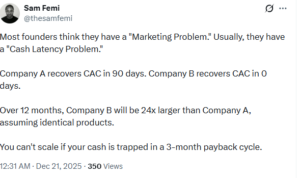
Monthly billing is killing your B2B AI startup.
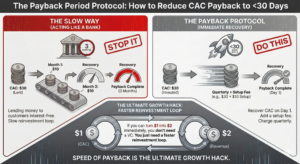
If your CAC is $30 and you charge $10/mo, you are acting like a bank. You are lending money to your customers for 3 months, interest-free.
Stop it and charge quarterly. Add a setup fee. Recover your CAC on Day 1.
If you can turn $1 into $2 immediately, you don’t need a VC. You just need a faster reinvestment loop.
Speed of payback is the ultimate growth hack.
1. The Velocity of Money Wins Wars
War is expensive. Your startup is at war against entropy.
To win a war, you do not just need ammunition; you need ammunition that refills itself automatically. Imagine two soldiers: Soldier A fires a bullet and has to wait a year to get it back, while Soldier B fires a bullet and gets it back in 30 days, allowing him to fire that same bullet twelve times before Soldier A even reloads.
Soldier A is dead.
Most B2B AI founders are Soldier A. You spend $5,000 to get a customer who pays you $400 a month, leaving you defenseless for over a year while you wait for the math to work.
The Payback Period Protocol forces velocity. It forces you to structure your pricing for cash upfront, to collect annual contracts, and to become a moving target that entropy cannot hit.
2. The Amazon Lesson: Bezos the Cash Architect
Let us look at history. Jeff Bezos did not just build a bookstore; he built a cash flow machine.
In the early days, Amazon was not profitable on paper, but Bezos operated with a negative Cash Conversion Cycle where customers paid him immediately, yet he didn’t pay his publishers for sixty days. He held the cash for two months, using his suppliers’ money to fund his growth without giving up a single percentage point of equity.
He did not wait for payback. He got paid before he spent.
You are likely doing the opposite, acting as a bank for your customers by paying your sales team and Google Ads today while waiting sixty days for the client to wire the funds.
Be like Bezos. Make them fund your growth.
3. Freedom from the VC Industrial Complex
I hate seeing founders beg. It makes me sick.
I see brilliant engineers pleading with VCs for a bridge round, willing to dilute their equity, give up board seats, and agree to insane terms just to survive another six months. They do this because they are addicted to the drug of slow payback, running models that consume cash rather than generate it.
When you have a 12-month payback period, you need a sugar daddy.
But when you shift to a 30-day payback period, the dynamic flips. You do not need their money because you are funding your own growth, which gives you the leverage to walk away from any deal that doesn’t serve you.
Ben Chestnut at Mailchimp understood this perfectly, refusing to take a dime of VC money and building a $12 billion empire because he refused to burn.
Mailchimp never took venture capital (VC) funds; they were entirely bootstrapped, growing organically through customer revenue for 20 years until Intuit acquired them for $12 billion in 2021.
Do not trade your freedom for a runway. Build your own.
4. Marketing Discipline Through Starvation
Abundance makes you stupid.
When you have millions in the bank, you get lazy, running sloppy ads to broad audiences because you have a cushion to absorb the failure. The Payback Period Protocol creates artificial scarcity, forcing you to look at every campaign with a microscope and kill anything that doesn’t return capital in 30 days.
This discipline filters out the garbage.
It forces you to become a sniper rather than a machine gunner, ensuring that every dollar you spend has a specific mission to come back home with friends. If it fails the mission, you fire the channel.
5. The Airbnb Survival Story
Look at Airbnb in 2008.
They were dead, unwanted by investors, and sitting on a runway of zero. They could not afford a long payback period, so they stopped acting like a tech company and started acting like survivalists, selling “Obama O’s” cereal boxes for forty dollars to generate the immediate cash flow they needed to keep the servers running.
They did not wait for a Series A to save them; they saved themselves.
They understood that cash in the bank today is worth more than equity tomorrow. Most of you are too proud to do this, too proud to charge setup fees or ask for money upfront, and that pride is expensive.
Do what is necessary to make the cash register ring today.
6. The “CAC” Lie and Vanity Metrics
Vanity metrics are poison.
I see founders celebrating cheap leads all the time, showing me dashboards with thousands of signups that cost fifty cents each. But when I ask how much revenue is in the bank from those leads, the answer is usually zero.
Those leads are trash. They are tire-kickers and tourists who will never pay.
The Payback Protocol destroys this vanity because it does not care about lead volume; it cares about revenue realized. You can afford to pay more than your competitors if you get it back faster, allowing you to outspend everyone while remaining profitable.
Stop optimizing for cheap. Optimize for realized value.
7. The Psychological Toll of Debt
Debt is not just financial; it is emotional.
A long payback period is a heavy load that weighs on your soul, waking you up at 3 AM to stare at the ceiling and wonder if churn will kill you before the LTV arrives. It drains your creativity, making you risk-averse and forcing you to play not to lose instead of playing to win.
When you switch to a 30-day payback period, the weight vanishes.
You sleep like a baby because you know that every dollar you spent is already back home. Your team sees a leader who is in control, a general who is confident because the supply lines are secure.
Get your money back fast so you can lead with power.
8. Churn Kills Slow Payback
Let’s talk about the silent killer: Churn.
In the VC model, you assume a customer stays for three years, spending huge money upfront banking on that future revenue. But if they leave in month four, you have subsidized their usage and walked away with a loss.
The market is volatile, and you cannot bank on three years of loyalty.
The Payback Period Protocol immunizes you against churn because if you get your money back in month one, you are safe even if they leave in month four. You have removed the risk of the future and secured the victory upfront.
Do not gamble on the future. Secure the present.
9. Speed of Learning
Innovation requires data, and data costs money.
If your feedback loop is 12 months, you learn slowly. By the time you realize a campaign was profitable, the market has shifted.
The Payback Protocol speeds up your learning curve because you know in 30 days if it worked, giving you twelve learning cycles in a year instead of one. The company that learns the fastest wins.
Force the money to move so your mind can move.
10. The Ultimate Filter for A-Players
A-Players want to be on a winning team.
They can smell a desperate company that relies on VCs to make payroll; it smells like fear. But when you show a candidate your financials and they see that you are customer-funded, that you print cash, and that you are sovereign, their eyes light up.
Discipline is sexy to high performers.
The Payback Period Protocol is the ultimate signal of discipline, telling the world that you are a serious operator who is here to stay. Build a company that A-Players fight to join.
The sun is setting on the era of free money. Winter is here.
You have a choice to make tonight.
You can continue to play the old game, burning cash and praying for a savior, or you can decide right now that you will no longer accept a payback period longer than 30 days. This choice will be painful, and it will require you to change your pricing, fire bad customers, and look at your business with brutal honesty. But it will save you.
But you cannot do this with a messy system.
You cannot execute this protocol with chaos. You need a machine. You need the Startup Growth OS.
If you are ready to stop bleeding and start building, I want you to apply to the Startup Growth OS. I do not work with everyone; I only work with founders who are obsessed.
If that is you, apply below.
Stop burning. Start building.
Sam Femi – The Growth Architect.